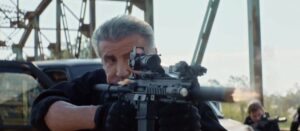
They’re safer and cheaper than squibs and pyrotechnics, but there are limitations to digital gore and bullet hits, Ryan writes.
Wildcat sees Kate Beckinsale in full combat mode. Pulling off great cartwheeling kicks, punching unsuspecting goons in the nose and generally being the all-round bad-ass we might recognise from her old Underworld franchise. (Okay, it’s possible to spot the odd stunt double here and there because their hair’s a different colour, but we’ll gloss over that.)
This London-set action thriller, directed by James Nunn, also has more than its share of shoot-outs, and it’s here that the low budget begins to tell – even more so than the reliably patchy dialogue (“Pass the marmalade,” says Charles Dance, awkwardly). Beckinsale’s character, an ex-special forces operative named Ada, wields several particularly huge guns in Wildcat, all of which have a feature common among modern genre films: a distracting lack of recoil.
Look, I’m British and no weapons expert, but even I know that machine guns are big and heavy. When the trigger’s pulled, there’s a huge eruption of gases and energy inside – essentially, an explosion in a confined space, the force of which propels the bullet out towards its target at around 1,000 miles per hour (yes, I did have to look that up).
The amount of recoil is going to vary depending on the gun in question, but even a pistol is going to provide that telltale bit of kickback that lifts the muzzle a few degrees after a shot’s been discharged. In Wildcat, we constantly see Ada – and other characters in the film – hoist aloft a huge-looking assault rifle, get a bead on a target, and mash their finger down on the trigger. We see a tiny flash of light from the barrel, maybe a lick of smoke – and that’s it. The gun doesn’t jam back into the shoulder; the muzzle doesn’t shudder from shock going on inside it.
The camera will then cut to the target, and we’ll see a smoky puff of blood splatter as the victim falls to the ground.
In filmmaking terms, it gets the job done. But to quote James Bond in Skyfall, “It’s not exactly Christmas, is it?”
Now compare scenes like these to their 80s and 90s equivalent. We could look at the boundary-pushing (and censor-baiting) bullet wounds in Sam Peckinpah’s The Wild Bunch. The heroic bloodshed of John Woo classics like The Killer or Hard Boiled. Or the frankly mad gunbursts and gore splatters of Paul Verhoeven’s RoboCop or Total Recall.
It would be wrong to call the gun battles in these films realistic, but they’re exciting and kinetic – we can almost feel the heat radiating from those guns and the energy of the squibs as they rip through cloth. Bullet hits in these movies feel explosive because they are miniature explosions – tiny detonators attached to a little bag of gore that bursts open when triggered.
The downside to those classic movies is that squibs and blank-firing guns are potentially dangerous. The hot gases that blast out of a firearm are still hot, compressed and can burn flesh even if there isn’t live ammunition inside. Anyone who’s read about the behind-the-scenes stories of The Crow (1994) or Rust will know how tragically things can go wrong when blank-firing weapons are used on a film set – though, thankfully, instances such as these are rare.
By the 1990s, the advent of CGI meant that things like muzzle flashes and bullet hits could be added in later using digital effects – meaning actors and stunt people no longer had to be rigged up with time-consuming, expensive and potentially painful exploding squibs. CGI could be used to simulate things like bullet holes in metal, wood and concrete – thus avoiding dangerous situations where there are sharp bits of debris flying around a set from a simulated bullet hit. And the guns no longer needed to fire blanks, allowing filmmakers to swerve expensive and time-consuming things like armorers and safety protocols.
In 2014’s John Wick, directors Chad Stahelski and Derek Leitch created a form of close-quarters action that would have ranged somewhere between the dangerous and the nigh-on impossible before CG. The franchise establishes a whole style where performers are in claustrophobic situations, often firing guns right in each other’s faces.
Directors like Sam Peckinpah or John Woo may have played fast and loose with safety issues that would have modern filmmakers reaching for the smelling salts, but even they would have struggled to find a way to re-create, say, the home invasion scene from the original John Wick that didn’t result in a stunt performer losing an eye.
The past 12 years have seen a succession of filmmakers follow the John Wick style, which has become the default mode for a wave of action thrillers with modest budgets: the colours are amped up, guns are fired often and at close range, often mixed with judo grapples and MMA throws. There will almost certainly be a fight in a night club, complete with pounding music and flashing lights.
One of the most surprisingly low-rent examples of post-Wick action – surprising given the stars attached – emerged on Prime Video last year. Mission Alarum starred Scott Eastwood, Sylvester Stallone, Willa Fitzgerald and Mike Colter in a listless backwoods yarn featuring lots of gunplay and posing. Despite a reported budget of $20m, Mission Alarum looks glaringly threadbare: there’s a plane crash, a big shoot-out involving jeeps in a forest, and rocket-propelled grenades fired into a townhouse. But every muzzle flash, bullet hit and gore splatter has clearly been added in Adobe After Effects, making the action set-pieces look like someone’s overlaid a bout of paintballing with off-the-peg CGI.
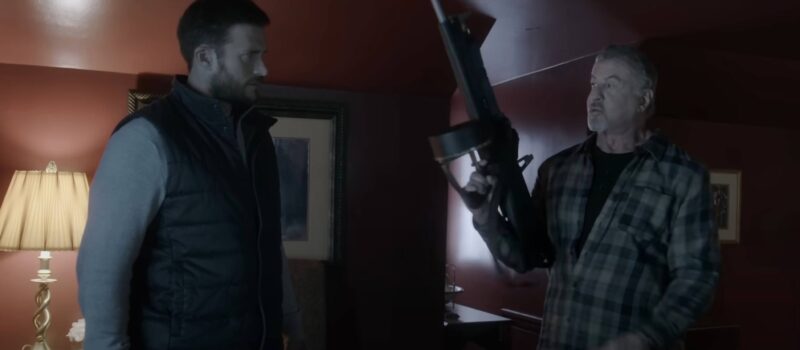
The general air of ‘will this do’ reaches its peak in a fiery sequence in which Eastwood and Stallone, trapped in a burning building lousy with bad guys, begin shooting their way out with absolutely gigantic AA-12 shotguns. The problem is, the guns clearly don’t fire anything – they’re almost certainly rubber props – and so our two Hollywood stars have to resort to faking the recoil by jerking their arms back at vaguely the right moment. It all has the faintly embarrassing air of catching two middle-aged uncles staging a pretend shootout in their back garden.
This is by no means Stallone’s only excursion into plastic gun action filmmaking. In 2024’s Armor, there’s a shoot-out on a bridge that is so comically ill-conceived that the YouTube channel Corridor Crew dissected it at length in one of its VFX Artists React episodes.
“His recoil isn’t even timed up with the smoke,” VFX expert Sam Gorski noted, as a grim-faced actor pretends to set off a distinctly light-looking grenade launcher, yanking his elbows back just like Eastwood and Stallone in Mission Alarum.
“I hate being mean about VFX,” says his colleague Wren Weichman, “but these look awful.”
There isn’t anything quite as glaring as this in Wildcat, and given that it isn’t an expensive Hollywood movie, the lighting and framing in some scenes looks rather polished. But the inherent drawback of CGI bullet hits and so forth still tells: there’s a sequence where a small army of bad guys liberally spray a car with bullets. We can hear the expected plink and pew of ammo slamming into metal and glass; but what we see are essentially CGI stickers popping up on the vehicle’s surface. Bullet holes appear on a windscreen, but there’s no accompanying shower of dust or tiny fragments of glass; the car doesn’t even shudder on its suspension from all the ballistic energy it’s absorbing.
The intention here isn’t to be scornful or mean to low-budget action movies – some of the best genre films of all time were made for tiny sums of money. Rather, it’s to question where modern filmmakers spend the resources they have available. In the case of films like Mission Alarum or Armor – wouldn’t it be better to tailor the action scenes to the budget rather than stretch it wafer thin?
Sure, the CG effects discussed here mean you can stage a Michael Mann shootout on a Roger Corman budget. But if the results look so unconvincing that they break an audience’s suspension of disbelief, wouldn’t it be better to simply come up with something smaller?
To cite two films I often think back to in these situations, Jeremy Saulnier’s thrillers Blue Ruin and Green Room were made for relatively small sums. Gareth Evans’ The Raid was shot for $1.1m – roughly a 20th of Mission Alarum’s budget. All of those movies contained exciting, convincing and sometimes quite horrifying action moments by designing the sequences around the resources they had available. None of them require their actors to wobble their arms to simulate a gun’s kickback.
To sum up: maybe it’s better to stage one brief, thrilling shootout rather than a dozen unconvincing ones.